
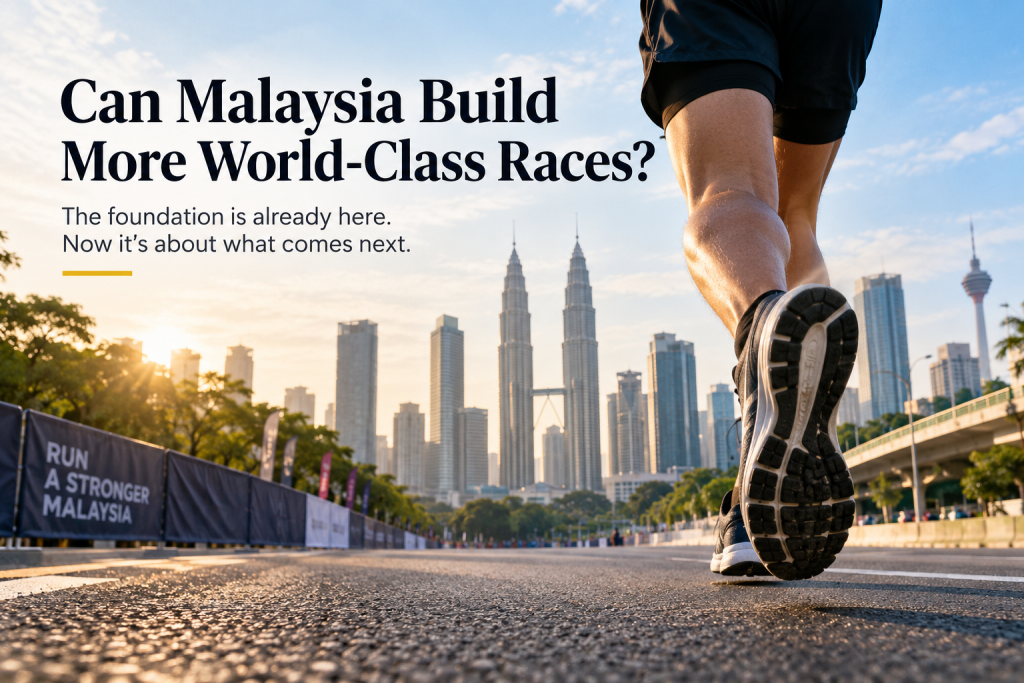
Malaysia has Built One of ASEAN’s Strongest Foundations for Internationally Measured Road Races

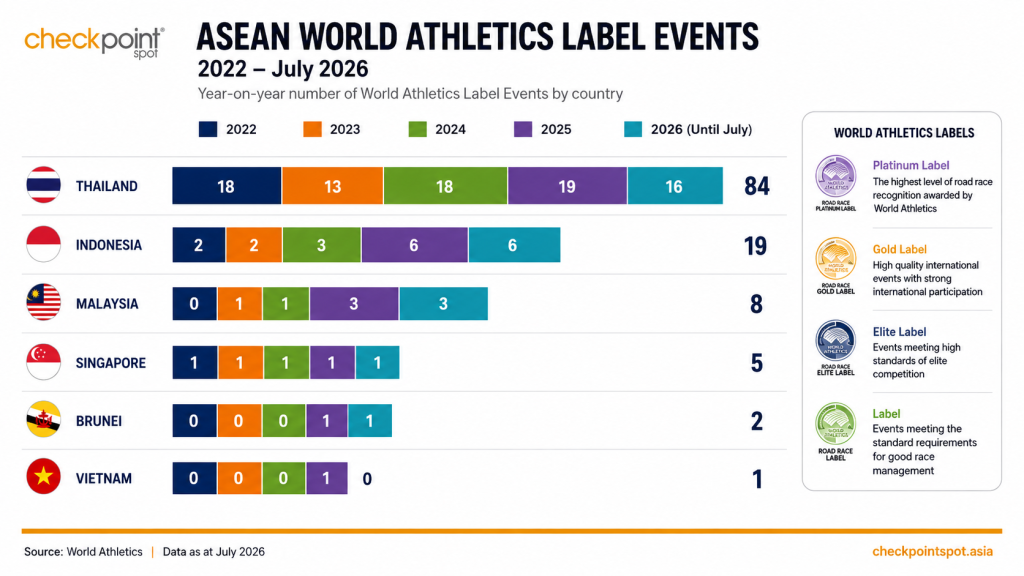
Malaysia has made steady progress in World Athletics Label events, but the regional landscape shows there is room to grow as the country works towards building more internationally recognised races. Source: World Athletics, data as at July 2026
The next step will require more than race organisers alone. It will take an ecosystem that sees running as part of Malaysia’s sporting, tourism and economic potential.
Malaysia has the courses. It has experienced race organisers, a growing running community and years of experience delivering major events.
So what will it take for Malaysia to produce more internationally recognised road races?
Benjamin Yeow, Group CEO of CheckPointSpot, believes the answer goes beyond organising bigger races. From his experience supporting events across Malaysia and several ASEAN countries, the next stage of growth will depend on stronger collaboration between organisers, sponsors, tourism agencies, government bodies, broadcasters, athletics organisations and industry partners.
It is a conversation worth having as road running continues to grow across Southeast Asia.
Malaysia is not starting from zero
Over the past decade, road running has grown beyond being simply a recreational activity. Across ASEAN, major races are attracting international participants, supporting sports tourism and giving cities another platform to reach visitors from around the region.
Malaysia already has an important advantage.
The country has the second-highest number of AIMS-certified road race courses in ASEAN. This reflects years of work by race organisers, course measurers, volunteers, local authorities and others who have contributed towards raising professional standards.
For Benjamin, this shows that Malaysia already has a strong foundation.
The question is how the industry builds on it.
A certified course is only the beginning
AIMS certification and World Athletics Labels are often mentioned when discussing international road races, but they recognise different things.
AIMS certification verifies that a race course has been accurately measured according to international standards.
World Athletics Labels look at the event more broadly, including areas such as the elite athlete field, anti-doping standards, international broadcasting, prize structures and organisational excellence.
In simple terms, having an internationally measured course is an important foundation. Building an internationally recognised event requires much more around it.
And this is where Malaysia’s next opportunity lies.
What can Malaysia learn from its neighbours?
There is no single formula for creating an internationally recognised race.
Thailand, Singapore and Indonesia have taken different approaches.
Thailand has built a broad portfolio of World Athletics Label races over the years, including Bangsaen21, ASEAN’s only Platinum Label event. Singapore demonstrates how a flagship race can grow into an internationally recognised sporting brand, while Indonesia has expanded its portfolio of Label races through continued investment and collaboration among different stakeholders.
These examples should not necessarily be viewed as a race between countries.
Instead, Benjamin sees them as useful examples of how different markets have approached the same challenge.
Malaysia does not need to replicate what its neighbours have done. But there are lessons to be learned from how these events have developed and the ecosystems that have grown around them.
The organiser cannot do everything
This is perhaps one of the most important parts of the conversation.
When an event wants to achieve higher international recognition, it is easy to place the responsibility on the race organiser.
But many of the requirements extend beyond what an organiser can realistically manage alone.
International broadcasting, elite athlete recruitment, long-term prize money commitments, anti-doping programmes, international marketing and destination promotion all require different resources, expertise and investment.
That means building a world-class race cannot simply be an organiser’s project.
Sponsors need to see the long-term value of endurance sports. Tourism agencies can look at races as destination marketing opportunities. Broadcasters can help local events reach international audiences, while government bodies can consider how endurance events contribute to tourism, health and economic activity.
Technology providers, athletics bodies, commercial partners and the running community also have roles to play.
The bigger the ambition, the more important that ecosystem becomes.
A race can be more than a sporting event
There is also a bigger opportunity beyond what happens on race day.
An internationally recognised event can give people another reason to travel to a destination.
Runners coming from outside Malaysia do not only participate in a race. Their trip can also involve accommodation, transportation, dining and other activities around the destination.
This changes the way a major running event can be viewed.
Instead of seeing it purely as a sporting activity, there is an opportunity to look at how running events can become part of a destination’s wider tourism story.
This leads to a different question.
Rather than asking why Malaysia has fewer higher-tier races than some neighbouring countries, perhaps the industry should be asking what it would take to develop Malaysia’s next internationally recognised flagship race.
Does every Malaysian race need international recognition?
No.
And Benjamin believes this distinction is important.
Not every Malaysian road race needs to pursue a World Athletics Gold or Platinum Label. Different events have different objectives, audiences and communities.
A community run does not need to become an international event to be considered successful.
But at an industry level, Malaysia can still have the ambition to develop more races that attract international recognition and bring runners from other countries here.
Doing that requires a longer-term view.
It means looking beyond one edition of an event and asking what Malaysia’s running landscape could become over the next several years.
Building the next chapter together
Malaysia already has much of the groundwork.
It has internationally measured courses, experienced organisers and an established running community. Years of work have also gone into developing the technical and operational experience needed to deliver major road races.
The next chapter does not have to be about Malaysia competing with Thailand, Singapore or Indonesia.
It can be about learning from what has worked across ASEAN and creating an approach that makes sense for Malaysia.
For Benjamin, stronger collaboration will be key.
If race organisers, tourism bodies, sponsors, broadcasters, government agencies, athletics organisations, technology partners and the running community can see the opportunity from the same perspective, Malaysia has the potential to create races that international runners do not simply discover, but deliberately travel here to experience.
World-class races are rarely built by one organisation.
They are built when an entire ecosystem sees the value of building them together.
About Benjamin Yeow


Benjamin Yeow, CEO of CheckPointSpot
Benjamin Yeow is the Group CEO of CheckPointSpot. Through his work in the race technology industry, he has supported road races and endurance events across Malaysia and several ASEAN markets. His experience provides him with a view of the operational and industry challenges involved in developing major running events.


